A useful starting point
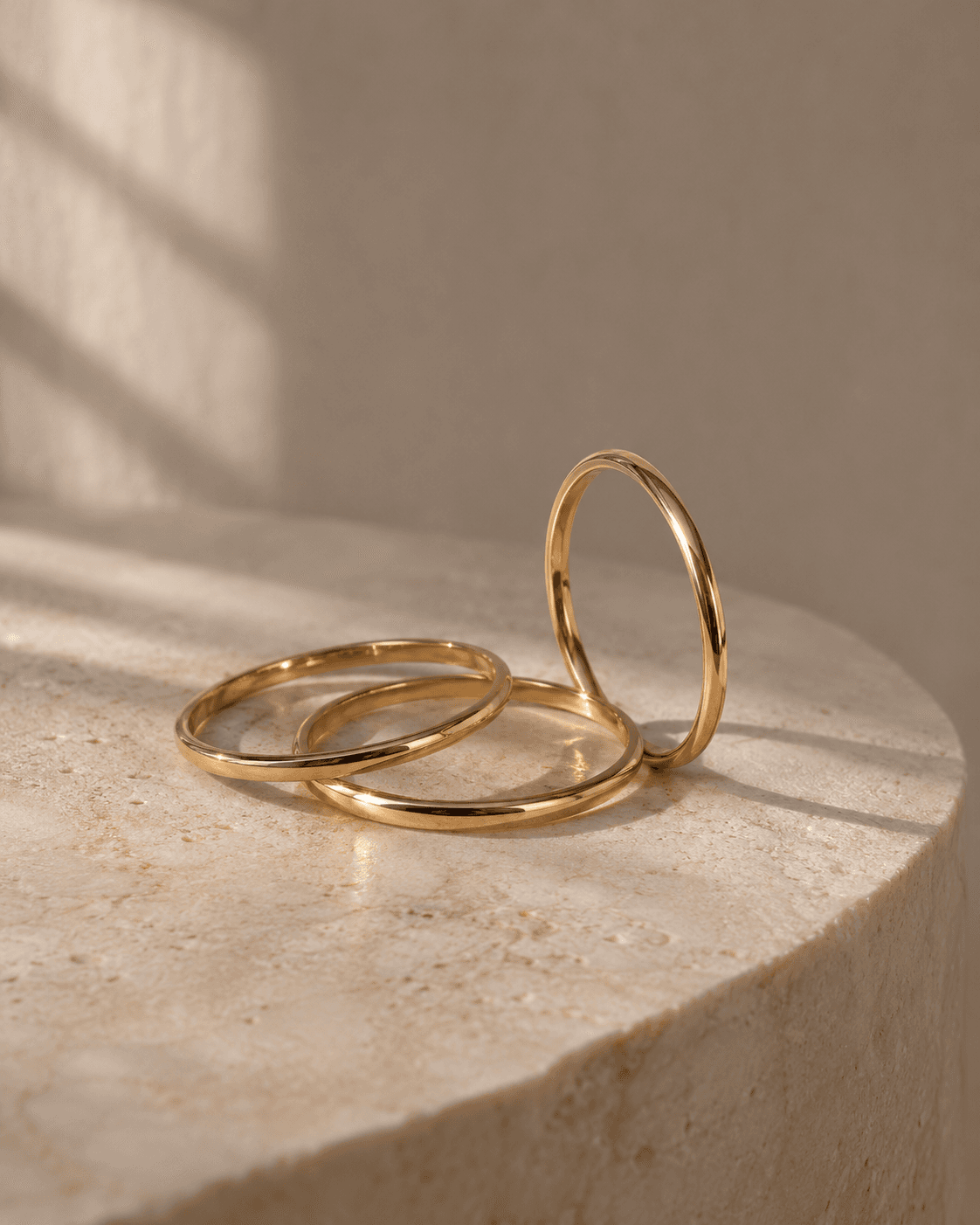
Start with one ring you love, add one contrasting band, then check the whole combination for comfort. A good stack leaves room for your fingers to bend and for each shape to be seen. There is no required number of rings.
Choose the piece that sets the mood
Lay out the rings you already wear and choose one as your starting point. It could be the broadest band, a curved profile or simply the ring with the most personal meaning. Wear it by itself first. This gives you a useful reference before the composition becomes more complicated.
Now add one ring and compare. If both pieces compete for attention, move one to the neighbouring finger. A stack can extend across a hand; the rings do not all need to sit on the same finger.
Three combinations worth trying
These are styling exercises, not sets for sale. Use similar shapes from your own collection and change one variable at a time.
| Starting point | Add | What to look for |
|---|---|---|
| A wider, smooth band | One slender band | A clear focal point with a quieter companion |
| Two fine bands | A little space on the next finger | A light rhythm without filling every finger |
| A curved or raised ring | A band that sits comfortably beside it | No forced contact with a setting or projecting edge |
Balance width, texture and colour
Think about the outline of the whole hand. Repeating one detail, such as a rounded edge, can connect otherwise different pieces. A polished surface beside a textured band creates contrast without requiring more rings.
Mixing warm and cool metal colours is a personal choice. Try repeating each colour elsewhere in the look, or let one mixed stack be the only contrast. Colour in a photograph is not proof of a piece’s metal content; check the actual material description separately.
Check the stack as a whole
A ring that feels comfortable alone may feel different next to several bands. Try the complete combination on the intended finger, gently make a fist and check the spaces between the rings. Do not force a tight stack over your knuckle.
For a purchase, compare the seller’s size system and band dimensions, and confirm the exchange or resizing terms before choosing. This guide does not convert your size or recommend automatically sizing up.
- Can your fingers bend naturally?
- Do any edges press into the neighbouring finger?
- Do raised settings touch or rub against another piece?
- Can each ring be removed comfortably without force?
Make an everyday version
Photograph two combinations against the same plain background. Compare them with your usual sleeve length and watch. If you keep adjusting one ring, remove it and live with the simpler arrangement for a while.
Your preferred stack can change with the occasion. Keep a note of which pieces feel best together rather than treating a styled photograph as a rule. For storage and cleaning, follow the instructions for the actual materials of every ring in the group.
A little more clarity
Your questions, considered.
How many rings should I stack?
There is no fixed number. Begin with two, check the fit, and add only if the result still feels comfortable and balanced.
Can I mix gold-coloured and silver-coloured rings?
Yes, as a styling choice. Compare the overall look and check each piece’s actual metal and care instructions independently.
About these notes
Prepared for OVE JEWELRY with AI-assisted research and writing. These are general styling and buying notes, not a report of product testing. Editorial images are AI-generated concepts. The OVE collection is not yet available to order.
Our editorial approach